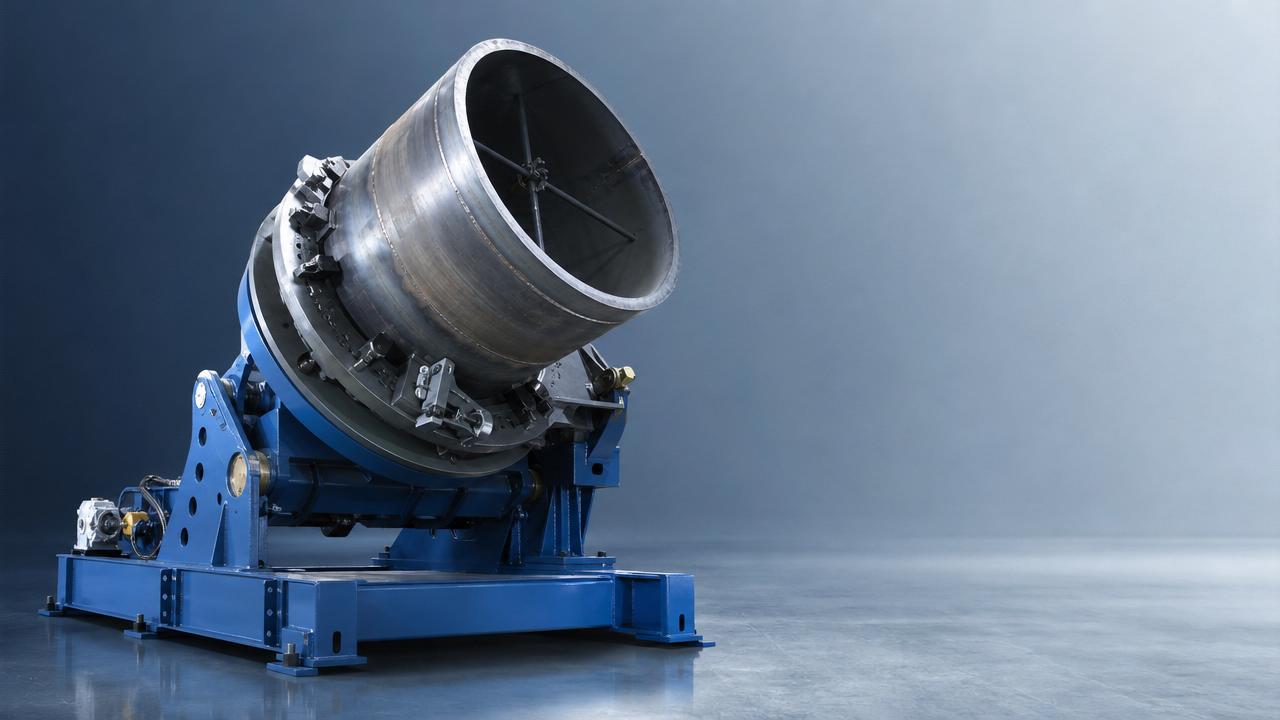
How Welding Positioner Capacity Affects Heavy Part Safety
For quality control and safety managers, welding positioner capacity is more than a specification. It directly affects stability, operator protection, weld consistency, and compliance.
Understanding how to choose a welding positioner for heavy parts helps reduce tipping risks, overload failures, and unsafe handling during rotation or tilting.
This article explains why rated capacity, center of gravity, torque, and fixture design must be evaluated together before selecting heavy-duty welding equipment.
What the Search Intent Really Means for Safety Teams
When users search this topic, they are usually not looking for a basic definition of a welding positioner. They need selection confidence.
Safety managers want to know whether a machine can rotate a heavy assembly without tipping, slipping, stalling, or exposing operators to uncontrolled movement.
Quality control teams also care about whether the positioner can hold repeatable angles, reduce weld defects, and support stable inspection conditions.
The practical question is simple: will the selected positioner remain safe and accurate under real shop-floor loading conditions, not only catalog conditions?
Rated Capacity Is Only the Starting Point
Rated capacity tells you the maximum load a positioner is designed to support under defined conditions. It is not a complete safety answer.
A 5,000 kg positioner does not automatically handle every 5,000 kg part safely. Load shape, overhang, eccentricity, and fixturing can change everything.
Many incidents occur because teams compare part weight to rated capacity, then ignore how far the load center sits from the faceplate.
For heavy parts, the safer approach is to treat rated capacity as one input within a broader load stability and torque assessment.
Center of Gravity Determines Real Stability
The center of gravity is one of the most important factors in heavy part positioning. It determines how the load behaves during rotation.
If the center of gravity is far from the rotation axis, the positioner experiences higher overturning forces, even when the total weight seems acceptable.
This is especially important for frames, tanks, pressure vessels, machine bases, and irregular fabrications with uneven mass distribution across the workpiece.
Before approving a positioner, safety teams should confirm the estimated center of gravity in both horizontal and tilted positions.
If the center of gravity cannot be calculated accurately, conservative assumptions and test lifting procedures should be used before production begins.
Torque Capacity Matters as Much as Weight Capacity
Torque is the rotational force required to move and hold the load. For heavy parts, torque often becomes the limiting factor.
A positioner may support the weight structurally, yet still lack enough turning torque to rotate the load smoothly and safely.
Insufficient torque can cause jerky movement, motor overload, brake stress, inaccurate stopping, or sudden shifting when the operator changes direction.
Safety managers should review both rotational torque and tilting torque, especially when parts are long, offset, or mounted with extended fixtures.
For high-risk applications, ask suppliers to verify torque calculations using actual workpiece dimensions, fixture weight, and expected welding positions.
Why Overhang and Eccentric Loading Increase Risk
Heavy parts rarely sit perfectly centered on a faceplate. Overhang creates leverage that can magnify stress on bearings, drives, and base structures.
The longer the distance between the load center and rotation axis, the greater the bending moment acting on the positioner.
Eccentric loading also affects operator safety because the part may accelerate unexpectedly when gravity assists movement during tilting or rotation.
This risk is higher when welding large assemblies that must be repositioned repeatedly throughout fit-up, welding, grinding, and inspection steps.
Capacity selection should therefore include maximum allowable eccentricity and overhang, not just the nominal load weight in kilograms or tons.
Fixture Design Can Protect or Undermine Capacity
Fixtures are often treated as accessories, but they directly affect the safety performance of a welding positioner for heavy parts.
A well-designed fixture spreads load evenly, supports the part securely, and keeps the center of gravity close to the rotation axis.
A poor fixture adds unnecessary weight, introduces imbalance, creates clamping uncertainty, and may reduce the usable capacity of the equipment.
Quality control teams should verify that fixtures maintain repeatable positioning, because movement during welding can affect root gaps, angles, and distortion control.
Safety managers should require documented fixture load ratings, locking methods, and inspection points before releasing the setup for production use.
Dynamic Loads Are Different from Static Loads
Catalog capacity is often based on controlled loading conditions. Actual welding operations introduce dynamic forces during start, stop, acceleration, and braking.
A load that appears stable when stationary may behave differently when rotated, tilted, or stopped quickly at an intermediate angle.
Dynamic loading becomes more serious when the workpiece is heavy, offset, clamped unevenly, or moved frequently during a welding cycle.
For safer operation, positioners should have adequate braking capacity, smooth speed control, and emergency stop systems suited to heavy loads.
Operators should avoid abrupt movements unless the equipment is specifically designed and tested for that operating pattern.
How Capacity Affects Weld Quality and Inspection Results
Capacity is not only a safety issue. It also affects weld consistency, inspection reliability, and the ability to maintain qualified procedures.
If a positioner struggles under load, welders may experience vibration, drift, poor access, or inconsistent travel angles during critical weld passes.
These conditions can contribute to lack of fusion, undercut, excessive reinforcement, inconsistent penetration, or rework caused by unstable positioning.
For quality control personnel, a properly sized positioner helps maintain repeatable joint orientation and supports more consistent visual and NDT inspection.
Stable positioning also reduces unnecessary handling, which lowers the chance of damaging finished surfaces, machined areas, or tack-welded assemblies.
Safety Margins Should Reflect Real Operating Conditions
Choosing a positioner at the exact calculated load limit is rarely a good safety practice for heavy-duty welding operations.
Safety margins should account for fixture weight, consumable buildup, dimensional variation, impact during loading, and possible future part design changes.
Many facilities apply conservative derating when parts are irregular, when the center of gravity is uncertain, or when rotation cycles are frequent.
The appropriate margin depends on application risk, regulatory expectations, company safety policy, and the reliability of load information.
When consequences are severe, it is better to overspecify capacity than to operate close to the mechanical or stability limit.
Compliance and Documentation Should Not Be an Afterthought
Safety and quality teams should not rely only on verbal supplier assurances. Capacity decisions need documentation that supports internal approval.
Useful records include rated load charts, torque data, allowable eccentricity, fixture drawings, maintenance manuals, and commissioning test results.
Risk assessments should identify pinch points, crush zones, emergency stop access, loading procedures, and restrictions on personnel standing positions.
Documented procedures help demonstrate that the company selected equipment responsibly and trained operators for foreseeable operating risks.
This matters during audits, incident investigations, customer reviews, and internal continuous improvement programs.
A Practical Checklist for Choosing a Positioner
Start by confirming the heaviest expected workpiece, including temporary attachments, backing bars, lifting lugs, and fixture components used during welding.
Next, estimate the center of gravity for each major orientation. Pay close attention to tanks, frames, and asymmetrical fabricated structures.
Then compare the application against rated capacity, torque capacity, allowable overhang, and eccentric load limits provided by the manufacturer.
Review fixture design to ensure secure clamping, repeatable positioning, easy inspection, and no interference with welding access or operator escape routes.
Finally, evaluate controls, braking, guarding, maintenance access, and emergency stop placement before approving the equipment for production.
Common Selection Mistakes That Create Hidden Hazards
One common mistake is selecting a positioner based only on the maximum workpiece weight listed in the purchasing request.
Another is ignoring the fixture weight, especially when custom tooling is thick, reinforced, or designed for multiple product variants.
Some teams also underestimate how much welding sequence changes loading conditions as the part is repositioned through different angles.
A further risk is assuming that a successful trial with one part proves safety for all similar-looking components.
For heavy parts, even small differences in geometry, wall thickness, or attachment location can change stability and torque requirements.
When a Higher-Capacity Positioner Is Worth the Investment
A higher-capacity positioner can appear more expensive at purchase, but it may reduce risk and operating cost over time.
It can provide smoother movement, lower mechanical stress, longer equipment life, and fewer interruptions caused by overload alarms or maintenance issues.
It may also reduce crane dependency by allowing safer repositioning at the workstation, improving productivity and reducing handling exposure.
For quality teams, stronger and more stable positioning can reduce rework, improve inspection access, and support better weld repeatability.
The investment is usually easier to justify when parts are high value, safety exposure is significant, or rework costs are substantial.
What Safety Managers Should Ask Suppliers
Ask whether the quoted capacity applies to a centered load or includes eccentric and overhung load conditions similar to your application.
Request torque calculations based on your actual part dimensions, fixture design, rotation angle range, and expected operating speed.
Ask for allowable center-of-gravity offset values, brake performance data, and recommendations for safe loading and unloading procedures.
Confirm whether the equipment includes overload protection, controlled acceleration, emergency stop integration, and suitable guarding options.
A reliable supplier should be willing to discuss application details rather than only repeating the headline capacity rating.
Building a Safer Approval Process
The safest facilities treat positioner selection as a cross-functional decision involving production, welding engineering, maintenance, safety, and quality control.
This approach prevents a purchasing decision from being driven only by price, availability, or a simplified weight comparison.
A formal approval process should review the application, confirm technical assumptions, document residual risks, and define operator training requirements.
Trial runs should be performed without welding first, using controlled movement, clear exclusion zones, and close observation of load behavior.
Any unexpected vibration, drift, noise, brake delay, or fixture movement should be investigated before production use begins.
Conclusion: Capacity Is a Safety System, Not a Single Number
Welding positioner capacity affects heavy part safety through load stability, torque demand, fixture performance, braking reliability, and operator exposure.
For safety and quality teams, the key is to evaluate the complete loading condition rather than only the workpiece weight.
Understanding how to choose a welding positioner for heavy parts means checking rated capacity, center of gravity, torque, overhang, and fixtures together.
When these factors are properly reviewed, facilities can reduce tipping risks, improve weld consistency, and make equipment decisions with stronger confidence.
The safest choice is not always the smallest machine that can carry the load. It is the positioner that remains stable under real production conditions.
Leave A Message
If you are interested in our products and want to know more details, please leave a message here, we will reply you as soon as we can.