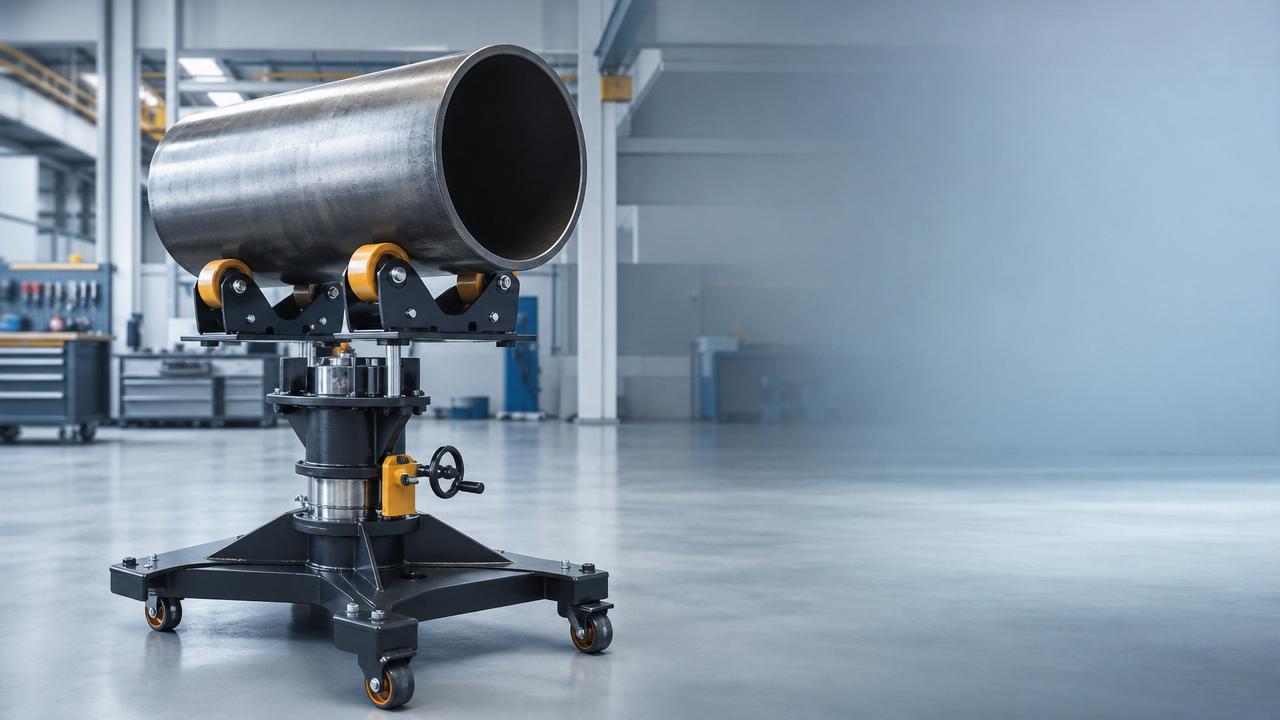
How to choose a pipe welding stand for 6-inch pipes? For researchers comparing welding equipment options, the answer depends on more than pipe diameter alone.
Load capacity, height adjustability, roller design, stability, material durability, and compatibility with different welding positions all affect safety and welding efficiency.
A well-matched stand can help reduce pipe movement, improve alignment, and support more consistent weld quality during fabrication, repair, and assembly work.
This guide explains the key factors to evaluate before selecting a pipe welding stand for 6-inch pipe applications.
What the Searcher Is Really Trying to Decide
Most people searching this question are not simply asking whether a stand can physically hold a 6-inch pipe.
They are usually comparing practical options and trying to avoid buying equipment that is unstable, undersized, inconvenient, or unsuitable for their workflow.
The real decision is whether the stand can safely support the pipe, help maintain alignment, and make welding easier without slowing production.
For information researchers, the most valuable answer is a decision framework rather than a single product recommendation or a generic capacity chart.
A good selection process starts with pipe weight, then considers adjustment range, roller type, working height, floor conditions, and welding process requirements.
Start with Pipe Weight, Not Just Pipe Diameter
A 6-inch pipe diameter gives only part of the story. Wall thickness, material, and pipe length can dramatically change the actual support requirement.
For example, a short thin-wall stainless pipe creates a very different load than a long schedule 80 carbon steel pipe.
Before selecting a pipe welding stand, calculate or estimate the heaviest pipe section the stand will need to support during normal use.
Then consider whether the pipe will be supported by one stand, two stands, or a combination of stands and a positioner.
A common mistake is comparing stand capacity to total pipe weight without considering how the load is distributed across supports.
Even when two stands are used, uneven placement or overhanging pipe ends can concentrate more load on one stand than expected.
Choose a stand with a rated capacity that includes a comfortable safety margin above your expected working load.
This margin matters because welding environments involve vibration, rotation, impact, imperfect floors, and occasional handling errors.
Check Whether the Stand Fits 6-Inch Pipe Geometry
After confirming load capacity, check whether the stand’s head or roller arrangement properly supports a 6-inch outside diameter pipe.
Some pipe stands support a wide diameter range, but the practical fit depends on roller spacing and saddle shape.
If the rollers are too close together, the pipe may sit high and feel unstable during rotation or tack welding.
If the rollers are too far apart, smaller pipe may sit too low or contact frame components instead of rolling smoothly.
For 6-inch pipes, look for a stand designed to support medium-diameter pipe with stable contact points and controlled rotation.
The pipe should rest securely without rocking, slipping, or requiring excessive manual correction during fit-up and welding.
Evaluate Height Adjustability for Your Welding Position
Height adjustability is one of the most important features when choosing a pipe welding stand for 6-inch pipes.
The stand must align the pipe with other equipment, such as pipe beveling machines, welding positioners, rotators, or adjacent pipe sections.
A stand that is too low can force welders into awkward postures, increasing fatigue and reducing weld consistency.
A stand that is too high may make fit-up difficult and increase the risk of pipe movement during handling.
Look at the minimum and maximum height range, but also check how easily the height can be adjusted under real workshop conditions.
Threaded screw adjustment offers precise control, while pin adjustment can be faster but may provide fewer height positions.
For fabrication shops handling different pipe sizes, a broader height range usually provides more long-term flexibility.
Choose the Right Roller or Head Design
The roller or head design affects how easily the pipe can be rotated, aligned, and held during welding.
For 6-inch pipes, roller stands are often useful when the pipe needs to be turned manually during welding or inspection.
Steel rollers are durable and suitable for rugged industrial use, especially with carbon steel pipe and heavy fabrication tasks.
Polyurethane or rubber-coated rollers can help reduce surface marking, which may matter for stainless steel, coated, or finished pipe.
Ball transfer heads allow multi-directional movement, but they may not provide the same controlled rotation as V-head roller stands.
V-head stands are simple and stable, but they may require more effort when rotating the pipe by hand.
The best choice depends on whether your priority is smooth rotation, surface protection, load strength, or simple stationary support.
Make Stability a Non-Negotiable Selection Factor
Stability should be treated as a safety requirement, not a convenience feature. Pipe movement during welding can damage work and injure operators.
A stable pipe welding stand should have a strong base, reliable locking mechanism, and enough footprint to resist tipping.
Tripod bases are common because they can adapt well to uneven floors, but base width and construction quality still matter.
Four-leg designs may feel more rigid on flat surfaces, though they can rock if the floor is not level.
Check whether the stand includes locking casters, leveling feet, or anti-slip contact points if mobility or floor variation is expected.
For 6-inch pipes, stability becomes especially important when pipe sections are long, unevenly loaded, or rotated during welding.
If the stand will be used near cranes, forklifts, or positioners, choose a model that tolerates shop movement and accidental contact better.
Consider the Full Pipe Length and Support Layout
A single stand may support a short 6-inch pipe section, but longer pipes usually require multiple support points.
The goal is to prevent sagging, maintain centerline alignment, and reduce stress on welded joints or tack welds.
When planning a support layout, consider pipe length, wall thickness, joint location, and whether the pipe will rotate during welding.
For long pipe sections, two or more stands may be needed, with spacing adjusted to reduce deflection.
When welding flanges, elbows, or assemblies, the center of gravity may shift away from the pipe centerline.
In these cases, stands with wider bases and precise height adjustment can help maintain alignment during fit-up.
Researchers should also consider whether the stand will be used alone or as part of a larger pipe fabrication setup.
Match the Stand to Welding Processes and Workflows
The right stand depends on how the pipe will be welded, not only on the pipe’s size and weight.
For manual TIG or MIG welding, the welder may need frequent pipe rotation and close access to the joint.
For stick welding in field repair, ruggedness, portability, and quick setup may matter more than smooth roller performance.
For shop fabrication, repeatability and compatibility with positioners or rotators can be more valuable than the lowest purchase price.
If fit-up is the primary task, choose a stand that helps maintain level alignment and allows controlled adjustment.
If circumferential welding is frequent, smooth roller action can save time and improve weld bead consistency.
If stainless or polished pipe is common, surface protection and contamination control should influence roller material selection.
Look Closely at Build Quality and Materials
A pipe welding stand works in a harsh environment, so construction quality directly affects service life and safety.
Heavy-gauge steel frames, reinforced welds, quality threads, and durable roller bearings are important indicators of reliability.
Powder-coated or painted surfaces can help resist corrosion, but coating quality should not hide weak construction.
Adjustment screws should turn smoothly without excessive play, because loose mechanisms make accurate height control difficult.
Rollers should spin consistently, support the rated load, and resist binding when exposed to dust, spatter, or shop debris.
If the stand will be moved frequently, inspect handle design, base strength, and caster quality where applicable.
Low-cost stands may appear acceptable for occasional light work, but they can become expensive if they reduce accuracy or fail early.
Portability Versus Rigidity: Which Matters More?
Some applications require portable pipe stands that can be carried to field jobs or moved between workstations.
Others require heavier stands that remain stable under repeated shop use and larger pipe assemblies.
Portable stands are useful for maintenance teams, mobile welders, and contractors working across multiple job sites.
However, lighter stands may offer less stability when supporting long 6-inch pipe sections or asymmetric assemblies.
Stationary or heavy-duty stands usually provide better rigidity, but they may be less convenient in flexible work areas.
The best choice depends on whether the stand will spend most of its time supporting production work or moving between locations.
If both needs exist, consider whether folding legs, removable heads, or lockable wheels offer a useful compromise.
Safety Features and Practical Operating Details
Safety is strongly affected by small details that are easy to overlook during product comparison.
Check whether the stand has reliable locking pins, secure adjustment collars, stable feet, and clear load rating information.
A stand should not drift downward, rotate unexpectedly, or shift position when the pipe is being fitted or welded.
Operators should be able to adjust the stand without placing hands in pinch points or under suspended pipe loads.
If the pipe will be rotated manually, the roller design should allow controlled movement rather than sudden uncontrolled rolling.
Also consider heat exposure, spatter, electrical grounding practices, and whether stand components can tolerate the welding environment.
Even a well-rated stand can become unsafe if used on an uneven floor or beyond its intended load range.
Common Mistakes When Selecting a 6-Inch Pipe Stand
One common mistake is buying based only on pipe diameter and ignoring wall thickness, length, and total assembly weight.
Another mistake is choosing the lowest-cost stand without checking height range, roller type, or base stability.
Some buyers also overlook surface protection, which can be costly when working with stainless, coated, or finished pipe.
Using too few stands for long pipe sections can cause sagging, poor fit-up, and unnecessary stress on tack welds.
Failing to consider compatibility with existing positioners, tables, or fabrication fixtures can reduce productivity after purchase.
Researchers should compare stands using real work scenarios rather than relying only on catalog specifications.
The right question is not simply whether the stand can hold 6-inch pipe, but whether it supports the complete welding task.
A Practical Selection Checklist
Before choosing a pipe welding stand for 6-inch pipes, define the heaviest and longest pipe sections you expect to handle.
Confirm the rated capacity and select a stand with a safety margin above the expected working load.
Check the supported diameter range and make sure the roller or head geometry works well with 6-inch pipe.
Review the height adjustment range and confirm it aligns with your welding tables, positioners, and preferred working posture.
Choose roller materials based on pipe surface requirements, rotation needs, and expected workshop conditions.
Inspect base design, locking mechanisms, adjustment hardware, and overall construction strength before making a final decision.
Finally, consider whether you need one stand, multiple stands, or a complete support system for longer pipe assemblies.
When a Standard Pipe Stand May Not Be Enough
A standard pipe welding stand is suitable for many 6-inch pipe applications, but some situations require heavier or specialized equipment.
If pipes are very long, thick-walled, or connected to heavy fittings, a higher-capacity support system may be necessary.
If continuous pipe rotation is required, pipe rotators or turning rolls may provide better control than manual roller stands.
If precision assembly is required, stands with fine height adjustment and stronger locking systems may be worth the additional investment.
For high-volume production, durability, repeatability, and operator ergonomics can affect long-term cost more than the initial purchase price.
In demanding environments, choosing a heavier-duty stand can reduce downtime, improve weld consistency, and lower safety risk.
Conclusion: Choose for the Task, Not Just the Pipe Size
To choose a pipe welding stand for 6-inch pipes, start with load capacity, but do not stop there.
The best stand should match pipe weight, diameter fit, height requirements, roller design, stability needs, and actual welding workflow.
For researchers comparing options, the most useful approach is to evaluate how the stand performs in real fabrication conditions.
A properly selected stand improves alignment, reduces unwanted movement, supports safer handling, and helps welders work more efficiently.
If a stand meets the pipe’s load requirements while improving fit-up, rotation, and working posture, it is likely a strong choice.
If it only fits the diameter but compromises stability or usability, it may create more problems than it solves.